
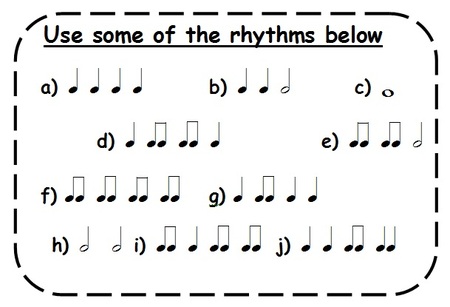
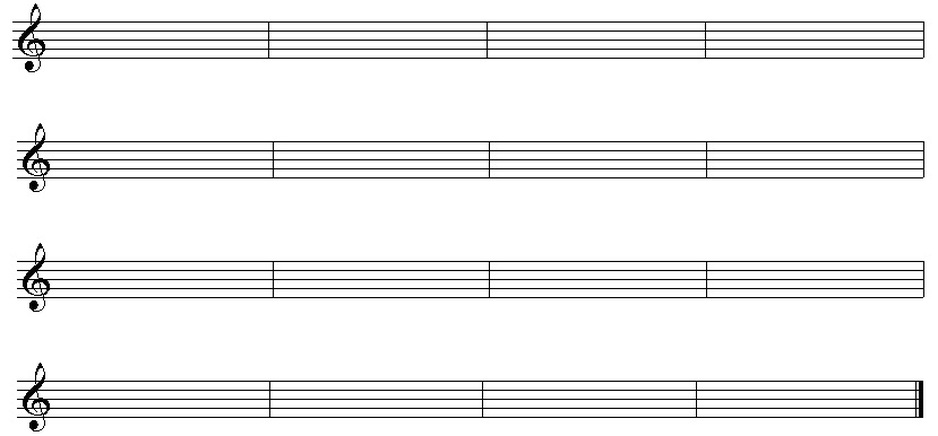
You've performed melodies written by other people, now it's time to write your own. Your melody will mainly move by step, but can have some leaps in it. There are some suggested rhythms in the box below, but remember to keep it simple.
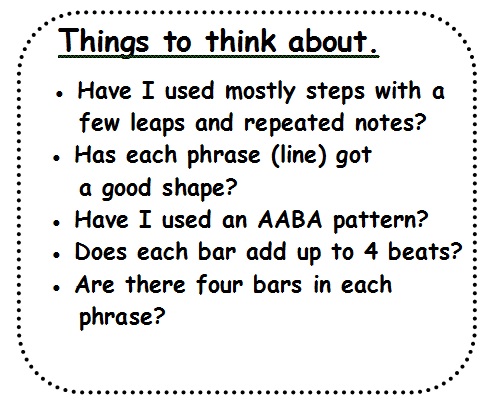
You will write your melody in 4 parts. Write the first line. This will be repeated to form the second line. Create something totally different for your third line, and then return to your first idea to end your piece. This will create an AABA structure. Each section will last for four bars. Your 'A' sections don't have to be exactly the same all the way through - the last bar might change.
You will write your melody in 4 parts. Write the first line. This will be repeated to form the second line. Create something totally different for your third line, and then return to your first idea to end your piece. This will create an AABA structure. Each section will last for four bars. Your 'A' sections don't have to be exactly the same all the way through - the last bar might change.
|
|

Composing Hints
Write your ideas on the stave in pencil - if you change your mind, its easy to adjust!
Use any note between C and top C. You do not have to use them all.
You can go outside this range if you really want to, but be careful that your melody does not loose its shape.
Start your piece on C or G.
End your piece on C.
If you get stuck, start again and keep it simple.
A steady, balanced rhythm will help the melody keep its shape.
Use longer notes (like minims and semibreves) at the end of a phrase.
Write your ideas on the stave in pencil - if you change your mind, its easy to adjust!
Use any note between C and top C. You do not have to use them all.
You can go outside this range if you really want to, but be careful that your melody does not loose its shape.
Start your piece on C or G.
End your piece on C.
If you get stuck, start again and keep it simple.
A steady, balanced rhythm will help the melody keep its shape.
Use longer notes (like minims and semibreves) at the end of a phrase.

Structure, Music and Food!
Music is put together using structure. Just as a house is built using scaffolding and books have a beginning, middle and an end, music is composed using different structures or forms.
We are going to look at the similarities between sandwiches and the structure of music.
We are going to look at the similarities between sandwiches and the structure of music.
|
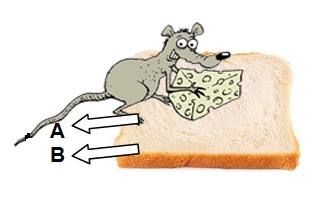
Binary Form (AB)
Just as cheese on toast has two ingredients, music in binary form has two sections. We label these sections ‘A’ and ‘B’. |
|
|
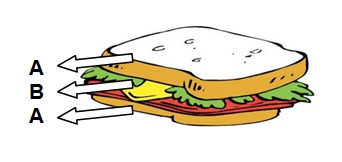
Ternary Form (ABA)
A sandwich has three layers Bread-Filling-Bread. Music in ternary form also has three sections and normally the B section contrasts with the A sections. |
|
|
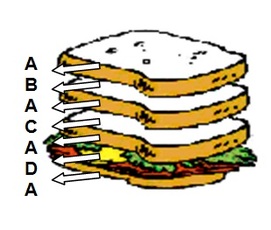
Rondo Form (ABACADA…) Rondo form is like a multi-layered sandwich with a different filling on each piece of bread. Music in rondo form has a section that is repeated over and over again. A different idea is sandwiched between each ‘A’ section |
|
You have now been commissioned by an events company to design three cakes for a music conference.
The three cakes must represent binary form, ternary form and rondo form.
Each layer must be labelled with a letter and the filling of your choice. (A will always be sponge!)
(Draw your cake designs into your booklets!)
The three cakes must represent binary form, ternary form and rondo form.
Each layer must be labelled with a letter and the filling of your choice. (A will always be sponge!)
(Draw your cake designs into your booklets!)